
The Essential Guide to DC Power Distribution Units
 In this article we will delve deep into the intricacies of DC Power Distribution Units in this comprehensive overview.
As technology continues its rapid advancement, the digital landscape is undergoing an unprecedented transformation. The rapid growth of artificial intelligence, IoT devices, cloud computing, and high-performance applications drives this change. It puts a huge and growing strain on the basic infrastructure.
As a result, organisations need very efficient and reliable power distribution systems. Downtime costs organisations millions of pounds, and energy consumption directly increases operational costs and environmental impact, pushing organisations to seek more optimal solutions.
In today’s fast-changing world, Direct Current (DC) Power Distribution Units (PDUs) have become very popular in recent years. This new method of managing power could change how we provide electricity. It will affect many IT devices and important systems. These systems support our digital world.
In this essential guide we will cover:
A DC Power Distribution Unit (PDU) is a special electronic device. It manages and distributes direct current (DC) power. This power goes to different connected equipment. You can find PDUs in data centres, telecom facilities, IT closets, and other important places.
At its heart, a DC PDU acts as an intelligent power strip for DC-powered equipment. It gets power from a main DC power input.
This input often comes from a rectifier system, a battery bank or DC generator. Then, it carefully sends this power through several output ports to different devices.
Designed with precision, these units provide a stable, dependable, and often monitored source of power. This stability ensures that critical systems—such as servers, networking equipment, telecommunications switches, and edge computing devices—remain operational without interruption.
DC PDUs convert AC power from the utility grid or a UPS into DC power. They use power components like rectifiers, inverters, and voltage regulators.
The rectifier converts the AC power into DC power by allowing current to flow in one direction only. If needed, the inverter changes DC power back into AC power. The voltage regulator keeps a steady output voltage, no matter how the input voltage changes.
After changing the AC power to DC, the device sends it to different connected equipment through multiple output ports. Users can set these output ports to give different voltage levels and current ratings. This helps meet the needs of the connected devices. Cables, typically connected to the equipment’s power input terminals, carry the DC power to the equipment.
Modern DC PDUs often have advanced monitoring and control features. These features let administrators check power use, temperature, and other conditions of connected equipment from afar. To ensure high availability and reliability, manufacturers equip DC PDUs with redundant power inputs and output circuits.
This backup system stops a single point of failure. It makes sure that connected equipment still gets power, even if one power source fails.
DC PDUs also have protection features. These include surge protection, overcurrent protection, and overvoltage protection. They help keep connected equipment safe from power issues and faults.
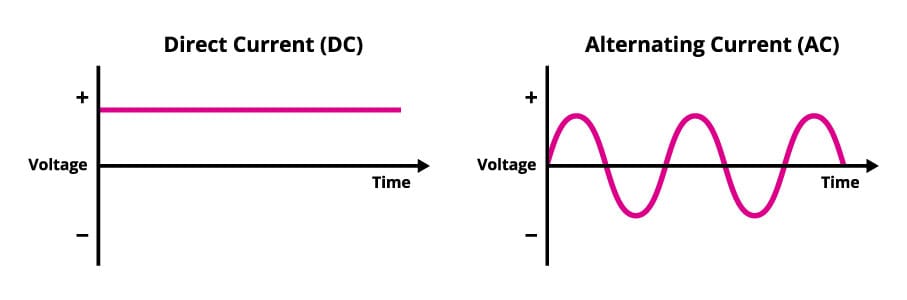
People broadly divide the world of electricity into two primary forms: Direct Current (DC) and Alternating Current (AC) power. While both transfer electrical energy, their fundamental mechanisms of electron flow and subsequent applications differ significantly, shaping modern technology and infrastructure.
- Direct Current (DC) power flows electric charge unidirectionally. Electrons always move in one direction.
They go from the negative terminal to the positive terminal. This movement creates a steady voltage and current over time. Imagine a steady stream of water flowing through a pipe – that represents DC power. - Alternating Current (AC) power causes electric charge to flow in an oscillating manner. The flow of electrons changes direction regularly. This causes both the voltage and current to keep changing in size and direction over time. Think of a paddle moving water back and forth in a pipe.
Despite their differences, AC and DC power often work in tandem. Devices that operate on DC internally (like your laptop or phone) plug into an AC wall outlet. The power adapter’s rectifier converts AC to DC. Conversely, solar panels generate DC power, but an inverter converts it to AC for grid compatibility.
However, DC power systems offer greater efficiency, longer lifespan, and less susceptibility to power quality issues than their AC counterparts.
Choosing the right DC Power Distribution Unit (PDU) is an important decision. It helps ensure the stability, efficiency, and safety of your DC powered systems.
To make an informed decision, you must assess various crucial aspects and factors:
- Power Rating: Focus on the Power Rating. This shows the highest current the PDU can safely handle.
The current is measured in Amperes (A). It may also show the total power, measured in Watts (W). Calculate the aggregate power consumption of all connected devices and ensure that your PDU’s rating comfortably exceeds this sum.
Best practices suggest keeping a headroom of 20-30%. This helps with safety and efficiency. It also allows for future growth or unexpected power surges without overloading the unit. Choosing a PDU with an insufficient power rating means, breakers may trip, the PDU can fail, or you risk fire hazards. - Input Voltage: Make sure the Input Voltage matches the DC voltage level your PDU gets from its power source. This can be a DC power supply, rectifier, battery bank, or another PDU. Common DC input voltages include 12V, 24V, 48V, or even -48V in telecommunications applications.
You need to make sure that your PDU’s input voltage matches the output voltage of your power source. If you mismatch voltages, it will render the PDU unusable or cause damage to the PDU or upstream source. - Output Voltage: Confirm that the Output Voltage complies with the DC voltage requirements of each connected device. Pass-through PDUs provide output at the same voltage as the input. Advanced PDUs can change the voltage or offer different output voltages for specific equipment.
You need to check that each output port or circuit gives the right voltage to your equipment. This helps prevent problems, damage, or lower performance. - Redundancy: Implement redundancy when you require high availability and critical uptime in your systems. Use features like dual A/B power feeds. This means the PDU has two separate input connectors. Each connector draws power from different sources.
You can use two separate PDUs for critical loads. Alternatively, choose PDUs with built-in ORing diodes. This will stop back-feeding and isolate failures.
By adding redundancy, you remove single points of failure in your power distribution system. This helps your critical systems keep running, even if one power source or part fails. - Remote Monitoring and Control: Allow remote monitoring and control to turn a passive PDU into an active management tool. This is especially useful in distributed or lights-out environments. Modern DC PDUs include built-in network interfaces (like Ethernet) that allow you to remotely monitor parameters such as:
- Input/Output Current and Voltage — viewing real-time power consumption per PDU or outlet.
- Temperature and Humidity — tracking environmental conditions within your rack.
- Breaker Status — quickly identifying tripped breakers.
- Alarm Thresholds — setting configurable alerts for overcurrent, undervoltage, or environmental excursions.
- Environmental Factors: Consider environmental factors critically as they influence the long-term reliability and safety of your DC PDU.
- Temperature Range — Select a PDU whose operational temperature range fits the ambient conditions of your rack or enclosure.
- Humidity — Pick PDUs that match the humidity level in your environment. High humidity can cause condensation and corrosion. Low humidity can raise the risk of static electricity.
- Dust and Particulates — In dusty areas, choose PDUs with higher Ingress Protection (IP) ratings. This helps protect internal parts from dust buildup, which can lead to overheating or shorts.
- Vibration and Shock — For industrial, mobile, or telecom applications, pick PDUs that withstand mechanical stress.
- Electromagnetic Compatibility (EMC) — Make sure your PDU meets EMC standards. This helps prevent interference with other sensitive electronics in your rack.
By looking closely at these important features, organisations can choose a DC PDU. This choice will meet their current power needs. It will also help keep their DC-powered systems reliable, efficient, and able to grow for many years.
 DC power distribution units deliver direct current power directly to equipment, minimising power conversion losses and ensuring continuous, stable power in critical environments.
Here is a look at their key applications:
- Data Centres need high uptime and energy efficiency. DC PDUs are important because they distribute power. They provide power to server racks and blade servers.
They also power storage area networks (SANs) and core networking equipment. This includes switches, routers, and firewalls. By providing direct DC power, they lower the many AC-DC-AC conversion points in traditional systems. This greatly reduces power loss and heat. - Telecommunication Systems: Telecommunications networks require extremely high reliability and continuous uptime, so DC PDUs distribute power to cellular base stations, central office exchanges, fibre optic nodes, microwave radios, network routers, switches, and other communication equipment in urban and remote locations.
- Renewable Energy Systems: As the world uses sustainable energy, renewable energy systems depend on DC PDUs. These systems help manage power from solar panels and wind turbines that produce direct current. They efficiently manage and distribute native DC power within these systems, connecting photovoltaic (PV) arrays, wind turbine generators, and battery storage banks to various DC loads or inverters for AC conversion.
- Industrial Applications: Various industrial environments deploy DC PDUs to ensure precise, dependable, and rugged power distribution for machinery and control systems.
DC PDUs underpin the functionality and efficiency of diverse critical infrastructure. They reliably and efficiently deliver direct current power supply, enabling modern technology to achieve greater energy efficiency, enhanced reliability, and safer operations across a wide range of applications
While data centre environments have traditionally relied on AC power, DC (Direct Current) Power Distribution Units (PDUs) are rapidly emerging as a superior alternative, offering a compelling array of advantages.
Key benefits include:
- Improved Power Efficiency: DC power systems inherently operate more efficiently than their AC counterparts. Traditional AC systems often need several AC-DC and DC-AC conversions.
This happens as power moves from the grid to the server. These conversions cause energy loss, mainly as heat. By sourcing power directly from UPS (Uninterruptible Power Supply) batteries, which naturally provide DC, these systems eliminate multiple conversion steps.
This direct power delivery significantly reduces energy consumption, lowering electricity bills. Also, less wasted energy creates less heat. This lightens the load on cooling systems. As a result, it leads to more energy savings and a smaller carbon footprint. - Increased Reliability: In critical environments where downtime is not an option, DC PDUs enhance power reliability and ensure continuous operation. Critical parts in IT equipment and UPS systems often use DC power. A DC distribution system lowers the chances of failure from many AC-DC conversions.
- Reduced Maintenance: DC power systems often last longer and demand less maintenance than AC systems. Their simplified power path contains fewer complex components prone to failure or wear.
- Enhanced Scalability: Data centres and important infrastructure need more power due to high-density computing, AI, and advanced analytics. DC PDUs provide built-in scalability. They enable easier accommodation of increasing power requirements without costly or disruptive overhauls.
Conclusion
In conclusion, modern data centres and critical infrastructure applications rely on DC Power Distribution Units (PDUs) as an essential component. DC PDUs provide a stable and reliable power source. This helps sensitive electronic equipment work well. It also improves system efficiency and reliability.
When choosing a DC PDU, think about power rating, input and output voltage, and redundancy. Also consider remote monitoring, control, and environmental conditions. By implementing DC power in your data centre or critical infrastructure, you can enjoy improved power efficiency, increased reliability, reduced maintenance, and enhanced scalability.